
Written by
Jonathan Taylor
Published on
Oct 2, 2025
The Era of Disposable Software
Digital marketing has entered an interesting time. You've got unprecedented power at your fingertips, but you might not know it yet. The martech landscape is changing, and a new approach to building tools is emerging—one that could fundamentally shift how you solve marketing problems.
Let's talk about disposable software.
The Problem With One-Size-Fits-All Tools
You know the drill. You need to create content, run a data analysis, or perform a content gap analysis. There are tools for these tasks, sure. But you're either getting priced out or finding that the functionality doesn't quite match what you need.
Take Trello, for example. I just renewed my annual plan—I've been a longtime user. But let's be honest: a Kanban board is something that could be a tutorial project for a web developer. The tool works, but what happens when you want something more tuned to your specific workflow? What if you need project management combined with client management and time tracking, all feeding into an analysis engine that runs programmatically?
You could cobble together five different tools and hope they play nice. Or you could build exactly what you need.
Enter Vibe Coding

Pioneer astronaut with retro suit using holographic AI interface
Vibe coding—using AI copilots to help with programming—represents a brand new channel for digital marketing. It's not about missing out if you don't do this. It's about recognizing that something new is becoming commonplace.
When you have a jam session with Claude or ChatGPT about your specific problem, you'd be surprised how far you can get. Yes, prototypes start simple. But with vibe coding, use cases pop into people's heads constantly. You develop solutions, outgrow them, build new ones, or use them as stepping stones to enterprise-grade tools.
Marketers are at their best when they're problem solvers. Curiosity drives innovation, and these new technologies let you apply that curiosity directly to building solutions.
My Stack of Disposable Software
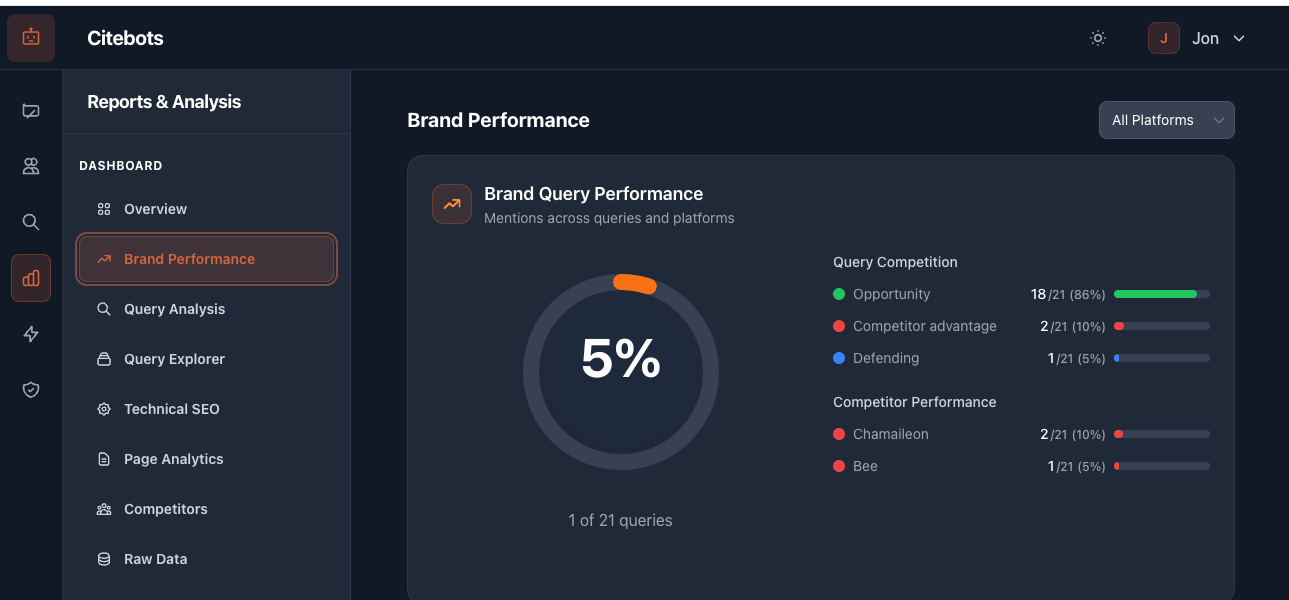
Example of my LLM visibility tool, Citebots
As a solo entrepreneur working in SEO and digital marketing, I use AI to accelerate what one person can accomplish. After 15+ years working with high-growth SaaS startups and enterprises, I've always found myself thinking: "Wouldn't it be cool if I had a solution that did this?"
Imagine if you could programmatically classify every page on your website—associating each with a persona, topic, and subtopic using semantic understanding and embeddings. Then connect that to Search Console data for follow-on activities.
These ideas would be great products, but the use case is often so complex and nuanced that getting the right output becomes the limiting factor. Standard tools serve large audiences. The applications you need are specific to your workflow.
Composable Meets Disposable
This disposable software idea rhymes with its companion trend: composable software. Composable is about having individual tools that coordinate and work together instead of one monolithic tool that does everything. Your CRM talks to your marketing automation system, which talks to your A/B testing platform, which connects to your personalization engine and project management tool.
I witnessed this trend firsthand. From 2011 to 2018, I worked as digital marketing lead for Klipfolio, a dashboard software company. Back in 2012, one of our most important capabilities was orchestrating data from various endpoints. The explosion of the martech space happened right in front of us. The tool was built to be agnostic, but overwhelming demand from marketers tracking data from disparate systems became our primary growth fuel for years.
The problem we solved wasn't just integrating data from multiple sources—it was making that data actionable. Composable software allows you to make better use of data, but keeping systems in sync becomes the challenge. That's why marketing operations and revenue operations have risen as technical disciplines.
Now, disposable software isn't meant to replace composable solutions. It's the fast and loose, output-oriented development style that digital marketers can embody. You take a problem, see a programmatic solution, scale it up, get value, and then—with ironic detachment—walk away from it.
The Scalpel, Not the Rocket Ship
We're trained in tech to think everything we build should be huge. But sometimes the smallest solution is best. Sometimes you just need a scalpel, not a rocket ship.
I recently had a conversation with a past colleague—a software engineer everyone recognizes as a star developer. He'd spent time helping me learn to code over the years. We were both building similar AI applications, so we shared notes.
His architecture blew me away. He had conversational flows that were mind-blowing, beyond my skill set. He handled security requirements, integration requirements, end-user requirements I hadn't even considered.
But when I showed him my system—nowhere near as commercial-grade—he found elements interesting from an AI architecture perspective. How do you control for quality? That quality control is the principal concern for any marketer. We poke fun at ChatGPT's obvious copywriting style (those em-dashes!), but these are things we need to engineer out of our systems.
My approach was different. I used modular formatting and an AI overseer concept that gathered feedback and evaluated whether new rules should be implemented. These conversations are how you take disposable software and turn it into something indispensable.
A Real Example: Content Gap Analysis at Scale
Let me share something I do in my practice: large-scale content gap analysis. There are lots of tools for this. Screaming Frog has an excellent ChatGPT integration that I use constantly. You load prompts, it takes crawl information, and returns responses.
But I wanted more. I wanted GPT to read the actual content. Then I wanted it to have context—why am I looking at this? What content gaps am I seeking? How do topics map to personas and content strategy?
So I built a scraping system for my clients. It programmatically crawls all their blog posts, providing metadata about topics, keywords, subtopics, and semantic relationships. I can feed it personas and other relevant information to get a nuanced understanding of what's happening with their content. Then I run analysis scripts that use all that contextual information to identify real gaps.
People pay me for this because it's not a cheat code—it's a leveling up of a process.
Breaking Down Barriers
Vibe coding gets a terrible reputation on social media. Developers see it as an assault on their expertise. Marketers feel intimidated by Visual Studio Code and generating code.
Here's my balanced take: vibe coding is absolutely viable. I've built publicly accessible software that my clients use successfully. But—and this is crucial—vibe coding doesn't replace engineers. You need a human in the loop at minimum.
After 18 months of building with vibe coding, I've gained massive respect for the engineers and architects I've worked with. The challenges we're solving often exceed the context windows of these tools. Building SiteBots for three months showed me the difference between disposable software and commercial-grade software up close.
Here's what you might not have heard: sometimes marketers don't need commercial-grade. Building something that works is what matters. Marketers have a unique ability to focus on outcomes, not architecture. With vibe coding, that's actually what you want.
Getting Started

First seedling of a growing colony
A friend of mine—senior growth marketer, super smart, marketing operations background—asked about vibe coding while we were on a call. VS Code intimidated him. Totally understandable. We all start somewhere.
We installed Copilot on his VS Code instance. I gave him a few tips, nothing special. By the next week, he had vibe coded a full-stack application running on his local server, collecting data, fully interactive. He'd never had a minute of JavaScript, Vue, or React training. Never heard of Node.js until he wanted to execute his idea.
Vibe coding is learned through trial and error. But there are accelerants. My background helps—years at Klipfolio understanding how APIs integrate, seeing data flow back and forth. I spent years teaching myself web development, probably reaching the level of passing an entry-level full-stack interview. Understanding data structures, how front-ends and back-ends communicate, the language of design—these accelerate your progress.
But these are skills you can acquire the old-fashioned way: trial and error.
The Future of Marketing Problem-Solving
Will this trend become standard practice for every marketing team? Probably not. But just like we saw the rise of growth marketing, revenue operations, and product-led marketing, a serious niche is developing that will provide brands with competitive advantages.
The biggest benefit for anybody? Clear articulation of your ideas. If you have a clear picture of what you want and you're smart about using ChatGPT or Claude, you can get AI to help plan the architecture. As long as you communicate clearly, you can accomplish a lot.
The era of disposable software isn't about replacing your tech stack or becoming a developer overnight. It's about recognizing that the distance between having an idea and building a solution has collapsed. For marketers willing to embrace this shift, the possibilities are endless.
You don't need to be a billionaire vibe coder. You just need tools that work for your specific problems. And now, for the first time, you can build them yourself.